
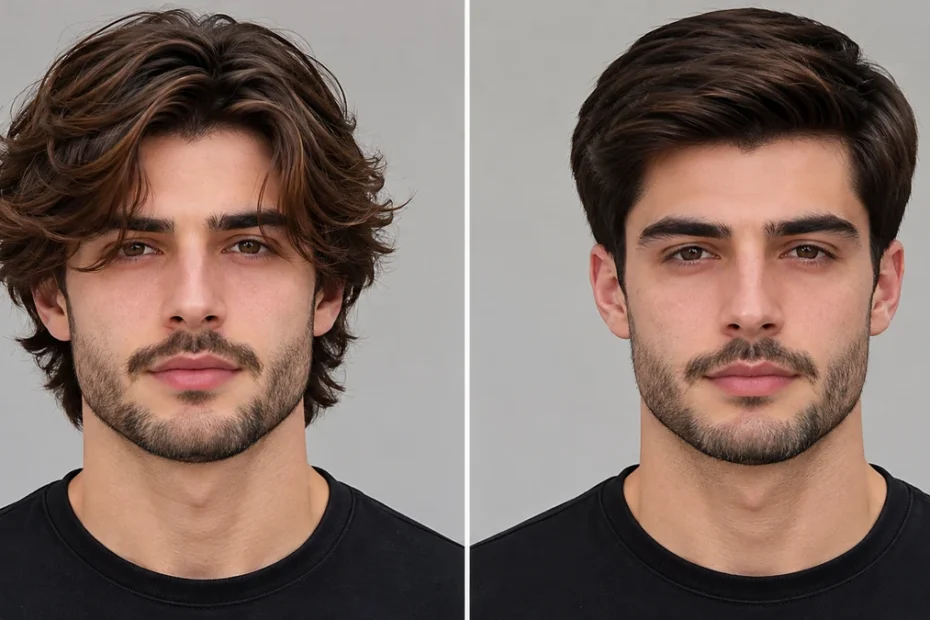
You sit in the chair and the barber asks one simple question: “Layers or one length?” Freeze up, mumble something unclear, and you walk out with a cut that fights your face for weeks. This guide removes that guesswork entirely. We break down layered haircuts vs non layered styles with real barber knowledge — styling, pricing, face shapes, hair types, and chair safety — so every visit delivers exactly what you planned.
What Are Layered Haircuts?
A layered haircut removes weight by cutting hair at multiple lengths across the head. Your barber lifts sections at 45° to 90° angles and point-cuts into the ends, creating graduated depth and natural movement that a single-length cut cannot produce.
Popular layer types your barber may suggest:
- Long layers — minimal weight removal, preserves length, blends smoothly during grow-out
- Short layers — maximum root lift near the crown, ideal for fine or thinning hair
- Face framing layers — taper from cheekbone to jawline, highlight bone structure
- Choppy layers — aggressive texturizing shears create a messy, modern edge
- Graduated layers — shorter at the back, gradually lengthen toward the front
Layers work on straight, wavy, and curly hair because varying lengths let each strand move independently. The American Academy of Dermatology confirms that multi-angle cutting changes light reflection across strands, producing visible volume without heavy product (aad.org).
What Are Non-Layered (Blunt) Haircuts?
A non layered haircut keeps every strand the same length from root to tip. Your barber holds hair at zero elevation and cuts a single clean line with sharp shears, producing a heavy, polished edge that looks sleek from every angle.
Popular blunt styles your barber may suggest:
- Blunt bob — sharp chin-length perimeter with zero texture
- One length trim — fresh clean edge on your existing length
- Straight-across fringe — heavy bangs cut at a uniform line
- Clean nape taper — sharp finish at the neckline
Blunt cuts shine on thick, straight, and coarse hair that already carries natural body. The uniform weight holds the shape for weeks with almost zero daily styling effort.
Layered Haircuts vs Non Layered: The Core Differences
The biggest difference is weight distribution. Layers remove weight from specific zones to create lift, texture, and dimension. Blunt cuts keep all the weight at the perimeter for a sleek, heavy finish.
When you compare layered haircuts vs non layered styles side by side, layers add movement while blunt cuts deliver a clean, uniform silhouette. Layers grow out softly and blend naturally. Blunt cuts show harsh lines the moment your hair grows even half an inch past the cut line.
Pros and Cons at a Glance
Layered Haircut Pros:
- Instant volume and root lift for fine or flat hair
- Adds movement and dimension to lifeless textures
- Face framing layers highlight cheekbones and jawlines
- Grow-out blends naturally without visible lines
Layered Haircut Cons:
- Requires 10–20 minutes of daily styling
- Needs trims every 6–8 weeks to maintain shape
- Over-layering thins out already sparse ends
Non-Layered Haircut Pros:
- Styles in under 10 minutes every morning
- Holds shape for 8–12 weeks between trims
- Creates a sleek, polished, professional finish
- Costs less due to simpler cutting technique
Non-Layered Haircut Cons:
- Adds zero volume to fine or flat hair
- Grow-out shows visible harsh lines quickly
- Limits styling versatility and texture options
Layered Haircuts vs Non Layered: Full Comparison Table
| Feature | Layered Haircut | Non-Layered Blunt Cut |
| Volume & Body | High — lifts flat roots | Low — weight pulls down |
| Styling Time | 10–20 min daily | 5–10 min daily |
| Trim Frequency | Every 6–8 weeks | Every 8–12 weeks |
| Best Hair Type | Thin, fine, wavy, curly | Thick, straight, coarse |
| Best Face Shape | Round, oval, heart | Square, oblong |
| Average Price | 25–60 | 15–40 |
| Grow-Out Phase | Blends smoothly | Harsh lines appear fast |
| Key Products | Mousse, texturizer, sea salt spray | Smoothing serum, light oil |
This layered haircuts vs non layered table gives you a quick snapshot before booking your appointment.
Which Cut Suits Your Face Shape?
Your bone structure decides which cut flatters you most:
- Round face → Long face framing layers elongate and slim the cheeks
- Oval face → Both layered haircuts vs non layered styles work perfectly on this versatile shape
- Square face → Soft wispy layers around the jawline soften angular features
- Heart face → Chin-length layers balance a narrow chin against a wider forehead
- Oblong face → A blunt cut with full bangs shortens the face and adds visual width
Which Cut Works Best for Your Hair Type?
Fine or thin hair needs layers. Short pieces near the crown remove drag and let roots lift naturally throughout the day. A blunt cut on fine hair falls flat within hours because the uniform weight drags everything straight down.
Thick or coarse hair thrives with blunt cuts. The uniform weight tames bulk and keeps the shape controlled without puffiness. Adding layers to very thick hair often creates unwanted volume at the sides.
Wavy or curly hair benefits from long layers that let each curl pattern spring independently. This prevents the dreaded triangle shape that forms when all the weight sits at the bottom.
How to Style Layered Haircuts Step by Step
- Apply a golf-ball amount of volumizing mousse to damp hair from roots to mid-lengths
- Blow-dry with a round brush, lifting each section upward at the root for maximum body
- Run a flat iron through the top layers only to create soft bends — skip the ends to preserve texture
- Finish with a light-hold texturizing spray to keep layers separated and bouncy all day
Layered haircuts vs non layered styling routines differ mainly in time — layers need roughly ten extra minutes each morning for noticeably more volume and dimension.
How to Style Non-Layered Hair Step by Step
- Apply two drops of smoothing serum to mid-lengths and ends on damp hair
- Blow-dry straight using a paddle brush on medium heat for a glass-like finish
- Flat iron the full length for a razor-sharp, polished look
- Tuck one side behind your ear or flip your part for a quick style switch
Blunt cuts practically style themselves, which is why many busy clients settle the layered haircuts vs non layered debate right here based on morning routine alone.
Pricing: How Much Will Each Cut Cost?
- Layered haircut: 25–60 (takes 30–45 minutes of precise sectioning and point-cutting)
- Non-layered blunt cut: 15–40 (takes 15–25 minutes of straight-line cutting)
- Add-on services (hot towel wash, blow-dry, styling): 10–20 extra
Layers cost more because the technique demands precision at multiple angles across the head. Budget barbershops may offer both cuts under $20. In the layered haircuts vs non layered price comparison, layers deliver more visual transformation per dollar spent.
How to Stay Safe in the Barber Chair
- Bring 3–4 reference photos from different angles so your barber sees exactly what you want
- Ask about their experience with your specific hair texture before they pick up the shears
- Request a consultation first — a skilled barber discusses layered haircuts vs non layered options and recommends what suits your face shape
- Inspect sanitation closely — clean tools, fresh capes, disinfected combs, and Barbicide jars are mandatory
- Speak up immediately — if the first few snips look wrong, say something before the damage becomes permanent
Milady Standard Cosmetology confirms that clear client-barber communication prevents the vast majority of haircut complaints and dissatisfaction (milady.com).
Best Tips Before Your Next Visit
- Wash your hair the night before, not the morning of — slightly dirty hair shows its true texture for accurate cutting
- Skip gels, waxes, and pomades on appointment day so your barber sees your natural hair behavior
- Mention any chemical treatments (color, keratin, relaxer) from the past six months because processed hair reacts differently under the shears
- Decide on layered haircuts vs non layered before arriving to avoid awkward mid-cut confusion
- Research in the Journal of Cosmetic Dermatology shows that clients who understand their hair structure before visiting the stylist report significantly higher satisfaction (onlinelibrary.wiley.com)
Conclusion
Pick layers if your hair feels flat, heavy, or stuck in one boring shape. Pick a blunt cut if you want a sleek, low-effort look that holds its shape for weeks. The right choice depends on your hair texture, face shape, and morning routine — not trends.
Book your next appointment, bring this guide on your phone, and tell your barber exactly what you want. Your best haircut is one clear conversation away.

Straight Hair Mullet: Cut, Style & Care Guide
Clean editorial lines · Gradual blend tips · Lightweight styling & 6–8 week trim schedule.
Read Guide
Two Strand Twist Men: Styles, Prices & Barber Guide (2025)
Short, long & loc variations · Real price tables · Tension safety & maintenance hacks.
Read Guide
Taper Mullet Haircut: 7 Stunning Styles You’ll Love
Low, mid, high & burst taper variations · Face-shape matching · Pricing & barber tips.
Read Guide
Mid Taper Fade Black Male Guide
Mid taper fade for black male hair · Face-shape matching · Barber tips & home maintenance.
Read Guide
Mid Fade Curly Hair: Best Styles, Costs & Barber Tips 2025
7 mid fade styles · Curl-safe styling routine · Real costs & barber communication.
Read Guide
Hair Extensions Guide: Types, Costs & Styling Tips 2025
Tape-in, sew-in, keratin & halo methods · Real price tables · Styling, safety & daily care tips.
Read Guide